The Original Over-Engineer
Leonardo da Vinci's man of math, drawn by an engineer, scientist and artist.
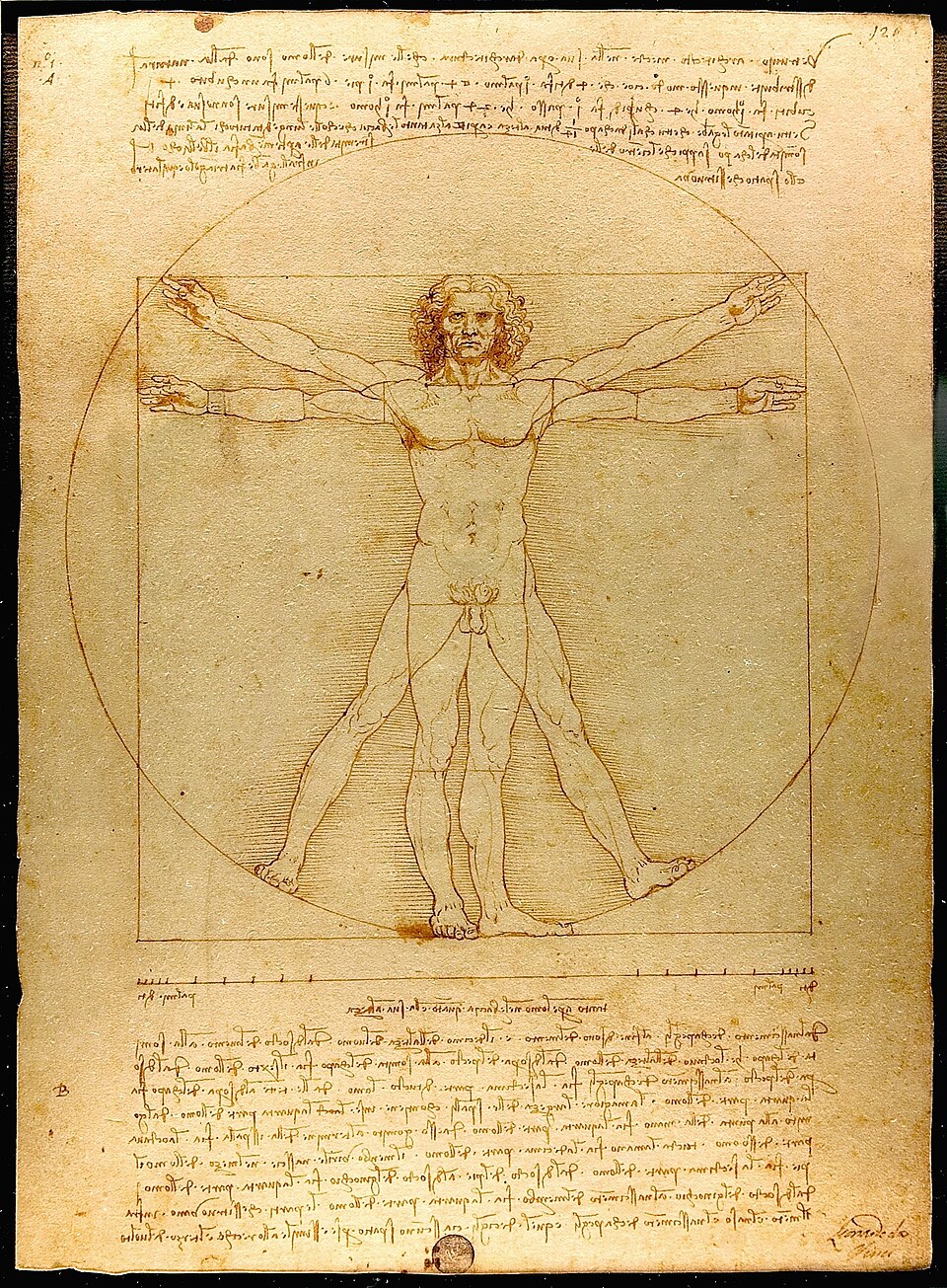
Around 1490, Leonardo da Vinci tested an idea from Vitruvius, a Roman architect, that the human body follows clean proportions. He drew one man in two poses, fitting inside a square and a circle at once: the circle centred on the navel, the square on the groin.
His notes beside the drawing read like a spec sheet. Vitruvius had written down about half of these ratios. Leonardo filled in the gaps and fixed the Roman's mistakes, like the foot. People are all different, but on average his numbers still hold: modern measurements back up what Leonardo worked out in 1490. Grab a tape measure and see how close you are.
The spec sheet
| Body part | Share of height |
|---|---|
| Arm span | Same |
| Groin | 1/2 |
| Shoulder width | 1/4 |
| Elbow to fingertip | 1/4 |
| Sole to knee | 1/4 |
| Knee to groin | 1/4 |
| Chest to top of head | 1/6 |
| Foot | 1/7 |
| Head | 1/8 |
| Elbow to shoulder | 1/8 |
| Face | 1/10 |
| Hand | 1/10 |
“Il piè fia la sectima parte dell'omo.”
The foot shall be a seventh of the man.
Every ratio here is translated directly from Leonardo's own Italian notes, written in mirror script above and below the drawing, c. 1490. The original sheet is held by the Gallerie dell'Accademia in Venice.